 Removals House Recycling & Sustainability
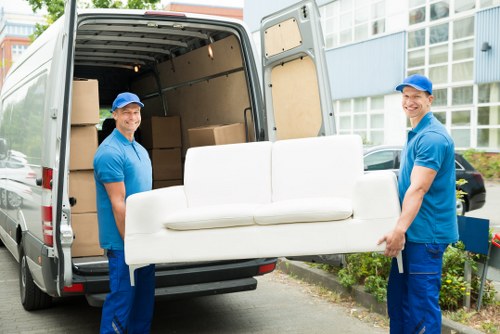
Removals House is committed to delivering environmentally responsible removal services throughout our boroughs. As a leading removals provider, RemovalsHouse integrates reuse, repair and recycling into every job. Our approach balances efficient service with measurable sustainability outcomes so that each move reduces landfill, supports local communities and aligns with council waste separation schemes.
 Our team understands the practical realities of local waste systems. Many boroughs operate multi-stream separation: dry mixed recycling, food and garden waste, and residual (black) waste are commonly collected separately. We work with that framework, making sure reusable items are sorted at source, small electricals and textiles are removed for specialist recycling, and food-contaminated materials are diverted away from clean recycling streams. This attention to local rules reduces contamination and improves recycling rates for the whole community.
Our Recycling Percentage Target
We have set a clear, time-bound target: a minimum of 75% recycling and reuse of collected household and commercial items from jobs by the end of 2028. This target covers anything we handle during a move that would otherwise become waste — furniture, mattresses, appliances, books, textiles and packing materials. The 75% goal is a company-wide ambition for removals-house operations and includes donation rates, materials sent to material recovery facilities (MRFs) and items repaired for resale.
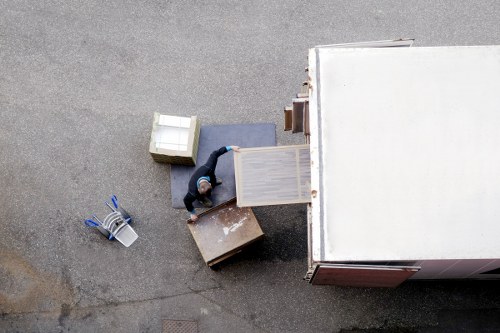 To hit this target we track a number of metrics: volumes sent to charities or social enterprises, tonnes delivered to local transfer stations, and percentages processed through borough MRFs. We report annually on progress and continuously refine our route planning, sorting procedures and partnerships. Transparency is essential: our clients receive summaries of what was diverted from landfill after each move, and our internal team uses that data to improve separation at source.
Partnerships with Charities and Community Groups
Removals House has formal partnerships with local charities and reuse organisations to maximize social value. We work closely with a network of charities who accept functional furniture, working appliances and small household goods. Typical reuse and recycling activities include:
- Furniture donation to local charities for redistribution to families in need;
- Textile and clothes collection for local social enterprises;
- Small electricals and e-waste channeled to certified recyclers;
- Books and educational materials donated to community centres and schools.
These relationships ensure that items with life left in them are reused locally, supporting borough-level circular economy initiatives while keeping costs and carbon lower than disposal. Our removals-house crews are trained to identify items suitable for donation and to record provenance for partner charities.
Local Transfer Stations and Material Flows
We maintain scheduled drop-offs at authorised local transfer stations and material recovery facilities. By coordinating with borough transfer hubs we keep truck time and double handling to a minimum. Typical material flows we use are: pickup from client -> in-vehicle sorting -> delivery to transfer station or charity partner -> onward to MRF or social reuse. This streamlined chain reduces carbon and increases the percentage of items that are reused or properly recycled.
 Working close to council waste strategies allows us to match our sorting standards to local expectations — for example, placing clean mixed dry recyclables with council MRF streams and directing food-soiled materials to anaerobic digestion where available. We also support borough bulky waste programmes by taking legitimate reusable items off the bulky waste queue and putting them back into local reuse channels.
Low-Carbon Vans and Fleet Decarbonisation
Our fleet policy is focused on low-emission, efficient operation. RemovalsHouse deploys a mix of electric vans for shorter urban journeys and low-emission diesel alternatives running on HVO (hydrotreated vegetable oil) for longer hauls where EV range remains impractical. Onboard telematics and route-optimisation software reduce idle time and mileage, lowering CO2 emissions per job. We measure fleet emissions and aim for an ongoing year-on-year reduction as part of our operational sustainability plan.
 In addition to vehicle electrification, our drivers are trained in eco-driving techniques and in practical on-site sorting to reduce trips. Combining low-carbon vehicles with smarter logistics is one of the most effective ways to make removals more sustainable without compromising service quality.
Commitment to Continuous Improvement: Removals House will keep refining processes, expanding charity partnerships and investing in low-carbon technology to meet our 75% recycling and reuse goal. We maintain detailed records of materials diverted from landfill and use those figures to inform training and operational changes.
Our sustainability program is not a static policy; it is an operational ethos. Whether you refer to us as Removals House, removals-house or RemovalsHouse, the promise remains: to make every move as low-impact as possible, to work cooperatively with borough waste separation systems, to support local charitable routes and to invest in greener vans and smarter logistics. We see sustainability as integral to modern removal services, not an optional add-on.
By choosing a responsible removal company Removals House, clients support local reuse economies, help reduce waste contamination in borough streams, and lower the carbon footprint of their relocation. We will continue to publish our progress, strengthen partnerships with community organisations and expand our reuse networks so that removals are part of the solution to waste and emissions challenges rather than part of the problem.